Industry Challenge: Passive Pothole Protection Struggles to Balance Mobility and Safety
For applications such as factory maintenance, commercial building upkeep, interior finishing, and equipment rental, conventional 12m mast aerial work platforms predominantly rely on passive pothole protection designs. These systems present inherent drawbacks: fixed ground clearance, delayed engagement, limited coverage, and the fundamental inability to reconcile chassis mobility with elevated stability. Under demanding ground conditions—uneven terrain, soft soil, aged construction sites—they often fail to provide adequate tip-over resistance.
The trade-off between mobility and safety has long challenged the industry. Many buyers actively seek aerial work platform protection solutions that operate automatically, require no manual adjustment, and adapt seamlessly to site conditions.
In response, Hynee has developed a fully automatic active pothole protection system specifically for mast-type aerial work platforms, integrating it into the HI12N self-propelled forklift-style vertical mast lift with jib. This system integrates four core technologies: mechanical linkage sensing, electro-hydraulic control, dual-condition triggering logic, and optimized chassis design—all aimed at overcoming the limitations of conventional passive protection.
II. Solution: Fully Automatic Active Pothole Protection System
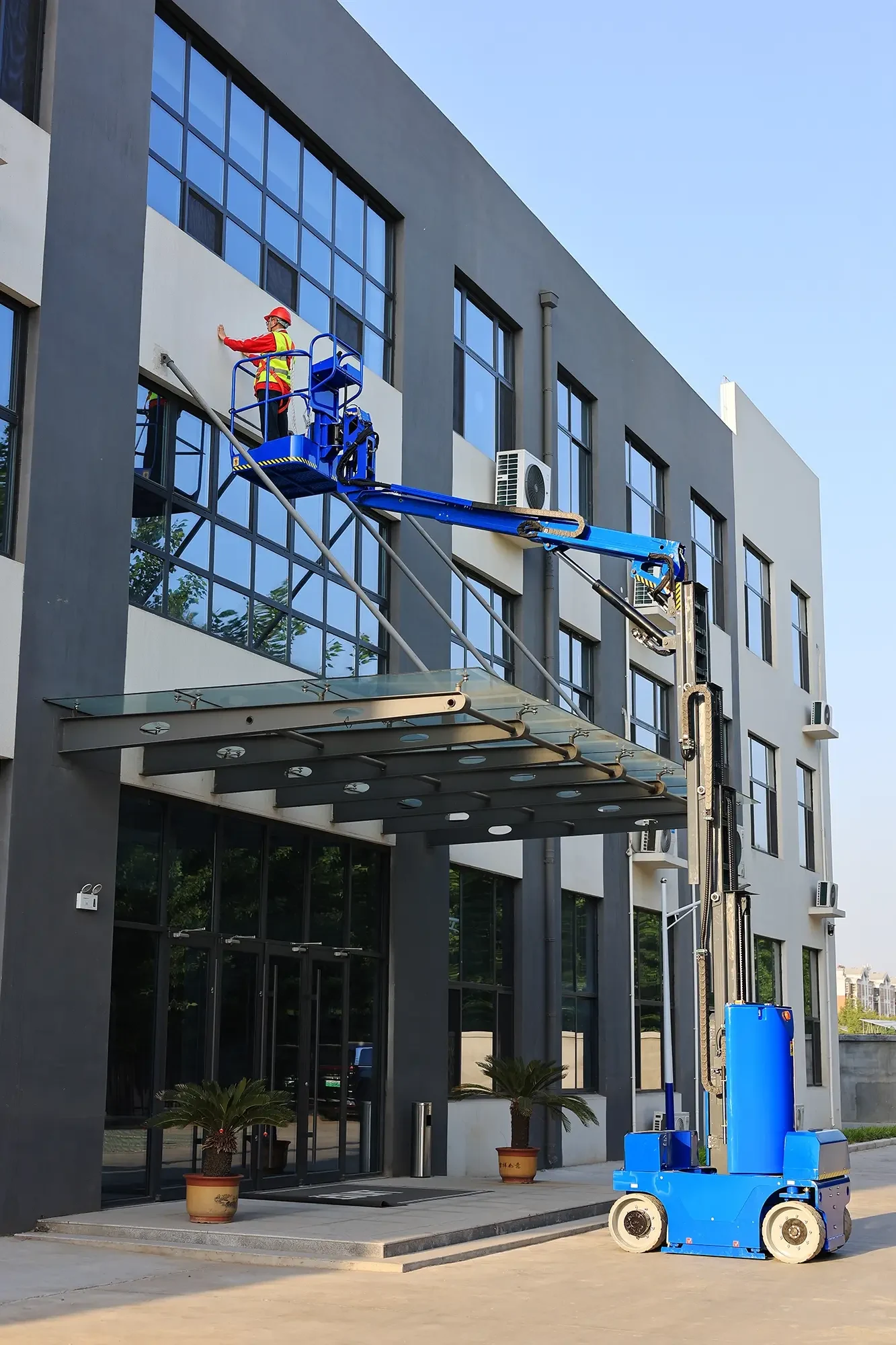
Active pothole protection technology has become a standard feature on scissor lifts and articulated/straight boom lifts. However, mast-type platforms, due to the complexity of combining a vertical mast with a jib articulation and the interlock logic required, have long lagged in adopting active protection at an engineering level. The HI12N closes this technology gap in the mast lift segment.
The HI12N's active pothole protection system utilizes a closed-loop control architecture of mechanical stroke triggering, electrical signal transmission, and hydraulic cylinder actuation. High-precision limit switches sense mast and jib movement, automatically deploying and retracting the pothole protection plates. The entire sequence operates without operator intervention: mechanical sensing covers key motion ranges of the mast and jib; electrical signal response occurs in milliseconds; and the hydraulic drive provides smooth plate movement with positive locking force. This design synchronizes aerial operation with pothole protection activation, eliminating safety gaps caused by operator oversight or system lag.
III. Trigger Logic: Dual-Condition Mechanism for Full-Condition Safety Coverage
The HI12N employs a dual-condition trigger logic based on mast lift and jib articulation—distinct from the single-condition (lift height only) logic common on many conventional mast lifts.
Under a single-trigger design, raising the jib alone while the mast remains stowed, or slightly raising the mast without reaching the set threshold, may fail to activate the protection system, creating a safety blind spot. The HI12N's dual-condition logic eliminates this: when the mast is raised by any amount or the jib articulation increases by ≥25% from the stowed position, either condition alone triggers the protection. In practical terms, once the work platform is elevated above the safe height—whether by mast lift or jib articulation—the protection system engages automatically.
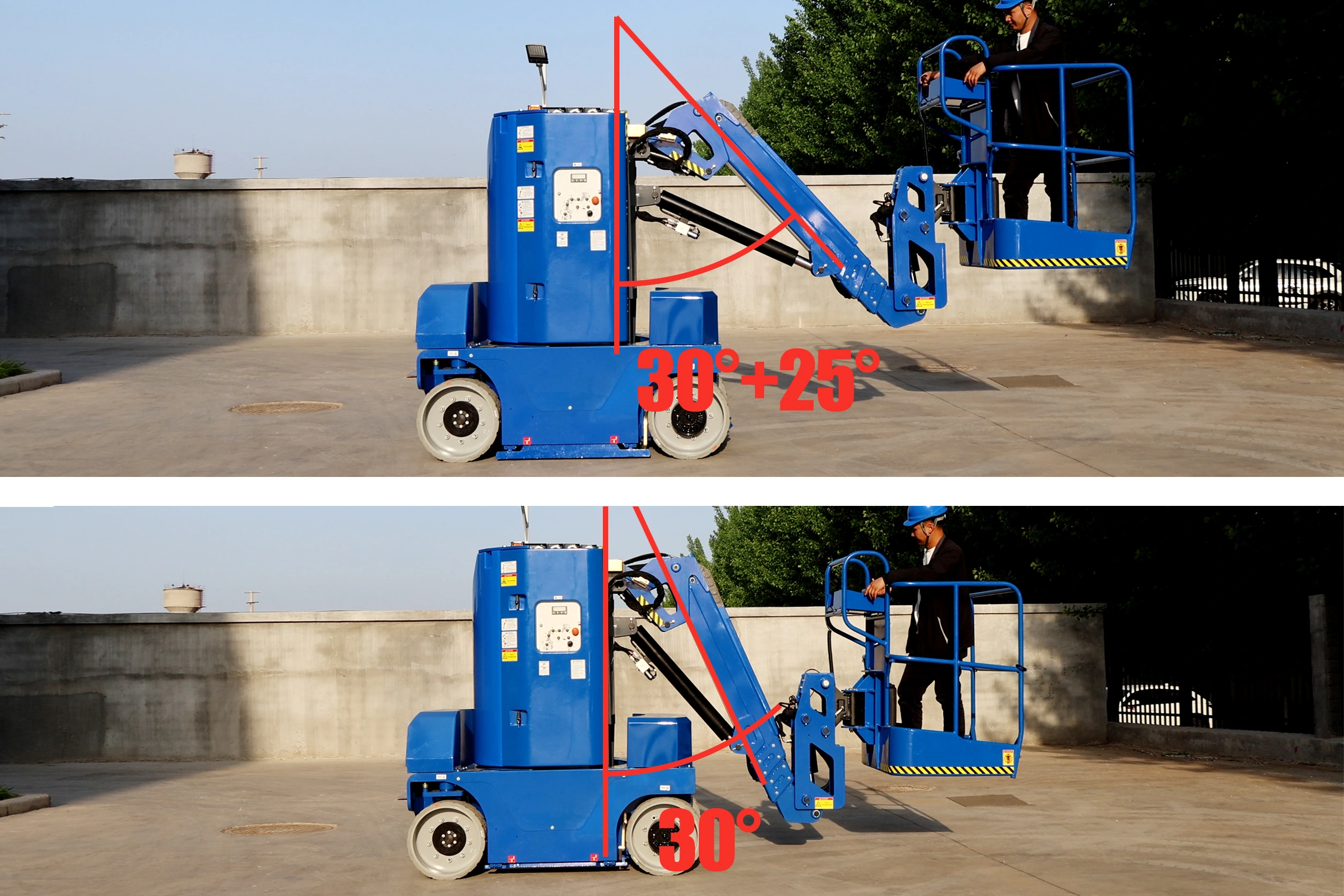
Field testing confirms that this dual-condition mechanism covers all typical working configurations: vertical lifting, jib over-obstacle operations, and combined movements. It achieves 100% activation of the pothole protection function under all elevated conditions, significantly reducing the risk of machine tilt or tip-over from ground irregularities or soft surfaces.
IV. Mobility Management: Dual-Mode Ground Clearance Switching
The active pothole protection system enables the platform to switch chassis ground clearance based on the machine's operating state, directly addressing the inherent conflict between low speed travel mobility and elevated working safety.
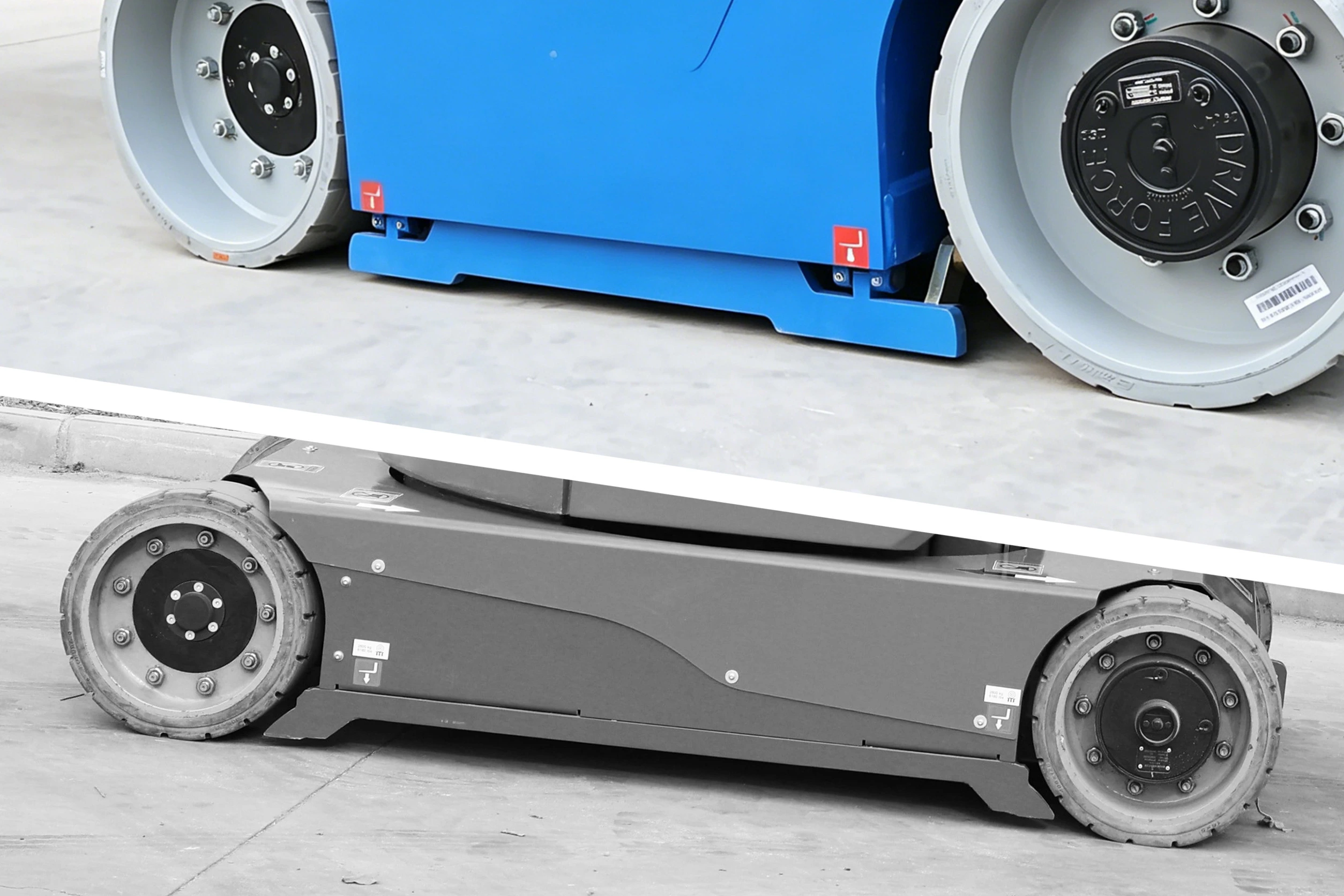
Stowed / Transport / Low-Speed Travel State: When the pothole plates are retracted, chassis ground clearance reaches 70 mm. This generous clearance allows the machine to pass over gravel roads, interior thresholds, warehouse aisles, and other job sites with minor obstacles, significantly reducing the risk of chassis scraping or impact.
Elevated Working State: With the plates deployed, ground clearance reduces to 20 mm. When encountering potholes, pavement gaps, or ground settlement, the deployed plates quickly support the chassis, restrict wheel sinkage, and prevent tip-over at height, stopping the wheels from dropping into surface irregularities deeper than 20 mm.
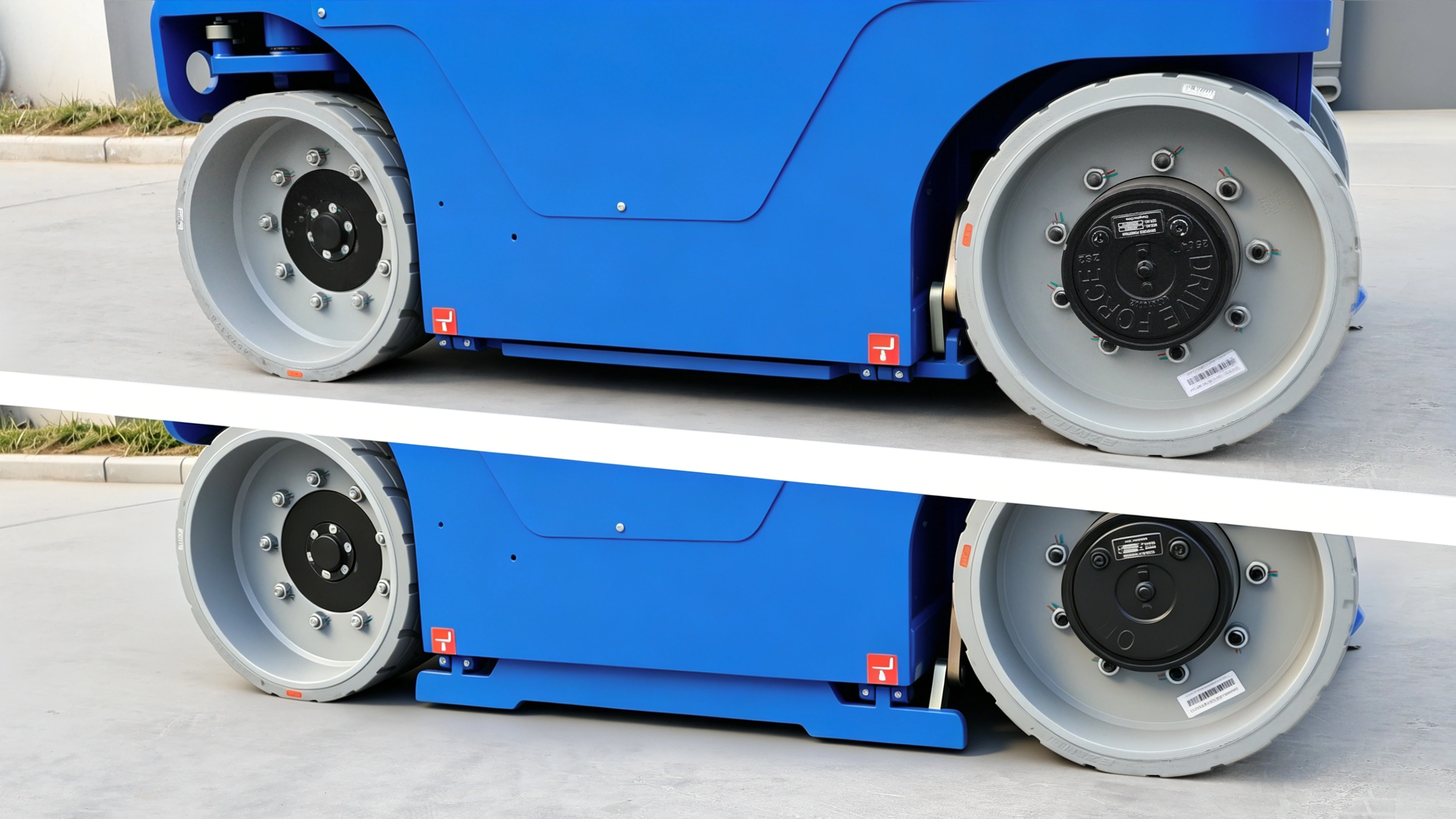
Unlike passive protection designs where fixed plates permanently occupy chassis space, resulting in tight, non-adjustable ground clearance, the HI12N's active system does not sacrifice low-speed travel mobility for elevated working safety. It fully adapts to both indoor and outdoor construction conditions, substantially improving the machine's ability to travel and maneuver in complex sites.
V. Extended Pothole Plate: Preventing Secondary Sink
When a wheel of an aerial work platform drops into a pothole, the chassis experiences a sudden downward impact. Under inertia, the pothole plate may slide forward after initial ground contact. If the plate is not sufficiently long, the machine can undergo a secondary sink event, compounding the forward-tip risk.
The HI12N's active pothole plates extend nearly the full length of the chassis. Once a wheel drops, the plate makes immediate ground contact and forms a support base, arresting the initial drop. Because the plate is long enough, it effectively prevents the machine from continuing to sink due to forward inertia, allowing the platform to come to a smooth stop with greater safety margin.
VI. Comparison: Active vs. Passive Pothole Protection
|
Comparison Dimension |
Hynee HI12N Active Pothole Protection |
Conventional Fixed Passive Pothole Protection |
|
Ground Clearance Mode |
Dual-mode automatic switching, adaptable to both states |
Fixed single clearance, non-adjustable |
|
Mobility on Uneven Ground |
Large-clearance design, no chassis drag |
Limited clearance, prone to impacts |
|
Anti-Tip-Over Performance |
Reduced ground clearance when elevated, greater safety margin |
Small passive plates, limited tip-over resistance |
VII. Technical Value and Application Outlook
The HI12N's integrated active pothole protection system—with dual-condition triggering, extended plate design to prevent secondary sink, and a mobility-safety balanced configuration—meets the pothole protection requirements of current aerial aerial work platforms manufacturer platform safety standards, including ANSI A92.20, EN280, and GB25849, while adapting to a wide variety of site ground conditions. From an engineering standpoint, this system provides a practical reference solution for the safety design of mast-type (forklift-style) aerial work platforms.
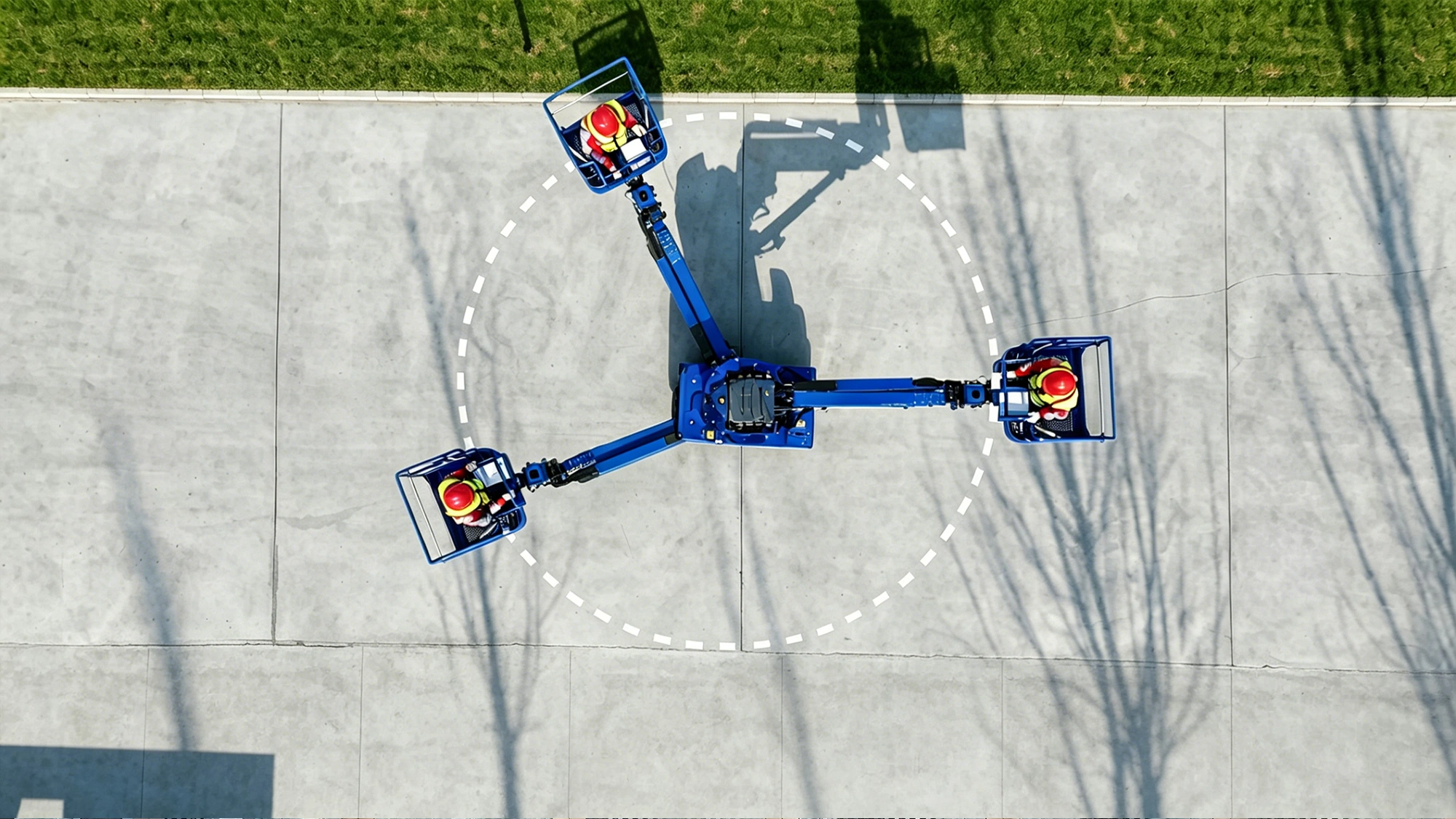
Combined with the HI12N's three other key features—narrow chassis, easy-maintenance mast, and 360° continuous turntable rotation—this model integrates safety, site mobility, low maintenance cost, and high work efficiency. Whether for confined indoor construction, complex outdoor job sites, or high-turnover rental fleets, the HI12N stands out as a strong choice among 12m mast aerial work platforms.
For customers who require both smooth job site mobility and safe work at height, this mast lift with active pothole protection is a top-tier option.