
Pinterest Automation can significantly reduce the time businesses, bloggers, creators, and marketers spend planning and publishing content. Instead of manually opening Pinterest every day, choosing an image, writing a description, adding a link, and publishing each Pin individually, automation tools can help organize and schedule content in advance. This makes it easier to maintain a consistent presence without spending hours on repetitive tasks.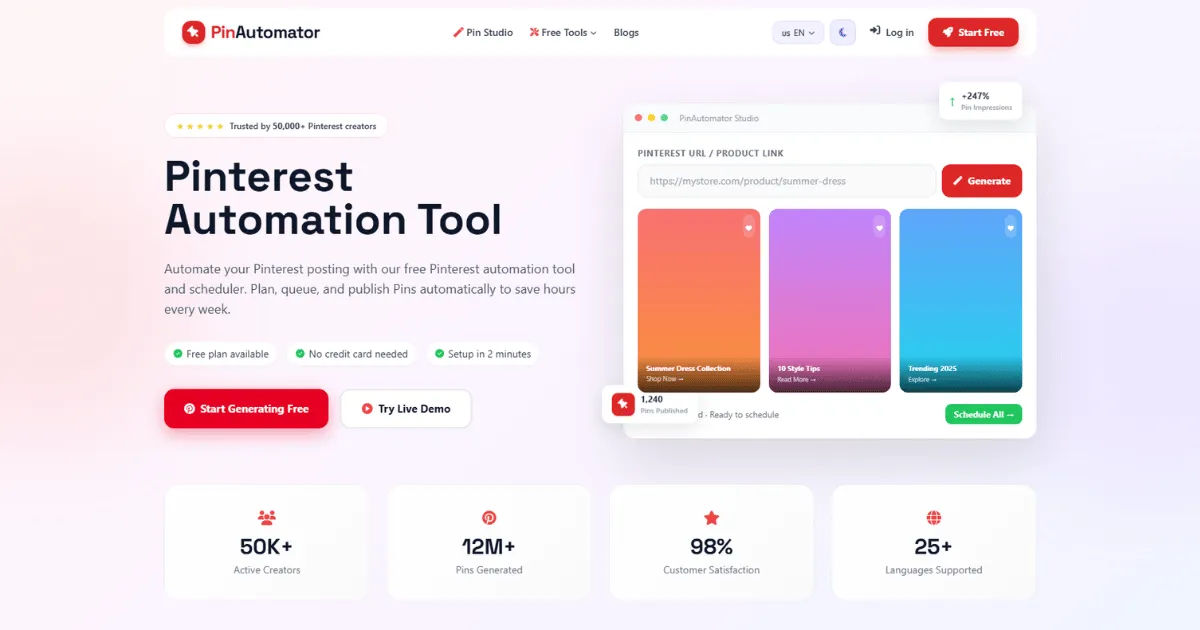
Time is one of the most valuable resources in digital marketing. While Pinterest can be an excellent platform for generating website traffic, promoting products, building brand awareness, and reaching new audiences, managing an active account manually can become difficult. The more content you want to publish, the more time you need to spend preparing and scheduling Pins.
This is where Pinterest Automation becomes useful. By planning content ahead of time and using scheduling features, marketers can create a more organized workflow. Instead of handling Pinterest activities every day, they can dedicate a specific amount of time to preparing content for the upcoming days or weeks.
However, automation does not mean that every part of Pinterest Automation should be left to software. Successful Pinterest marketing still requires creativity, strategy, research, quality content, and regular performance analysis. Automation is most effective when it handles repetitive scheduling tasks while the human marketer remains responsible for strategy and decision-making.
Understanding how much time automation can save depends on several factors, including the size of an account, the amount of content being published, the number of boards being managed, and the scheduling system being used. For some users, the time savings may be modest. For businesses managing hundreds of Pins, the difference can be substantial.
This comprehensive guide explores how scheduling works, how much time automation can save, what tasks can be automated, what still requires human attention, and how to build an efficient Pinterest workflow.
Why Pinterest Scheduling Takes So Much Time
At first glance, publishing a Pin may seem like a simple process. A user creates an image, uploads it to Pinterest, adds a title and description, inserts a destination link, selects a board, and publishes the content.
Doing this once is easy.
Doing it every day is more demanding.
For businesses and content creators, Pinterest marketing often involves publishing multiple pieces of content regularly. Each Pin may require a different image, headline, description, keyword strategy, destination URL, and board selection.
The process becomes even more time-consuming when a brand manages several websites, products, or Pinterest accounts.
Manual scheduling also creates interruptions. A marketer may be working on a blog post, product page, or advertising campaign when they suddenly need to stop and publish a Pin. These small interruptions may only take a few minutes, but they add up over time.
For example, spending 10 minutes publishing and organizing each Pin may not seem like a major commitment. However, publishing five Pins per day could require nearly an hour every day. Over a month, that can become a significant amount of working time.
Scheduling tools reduce these repeated interruptions by allowing users to prepare content in batches.
How Pinterest Automation Saves Scheduling Time
The main advantage of automation is that it changes the way marketers approach content publishing.
Without automation, Pinterest management is often based on daily tasks. A marketer logs into the platform, checks what needs to be published, prepares content, and manually posts it.
With automation, the marketer can work in batches.
Instead of spending 30 minutes every day scheduling Pins, they might spend two or three hours once a week preparing content for several days. The scheduling system then publishes the selected Pins according to the planned timetable.
This approach saves time in several ways.
First, it reduces repetitive actions.
Second, it makes content planning more organized.
Third, it minimizes the need to remember publishing times.
Fourth, it allows marketers to focus on other important responsibilities.
The exact amount of time saved will vary, but the overall principle is straightforward: the more repetitive publishing tasks you have, the more valuable scheduling automation becomes.
Batch Scheduling Reduces Repetitive Work
Batch scheduling is one of the most effective ways to save time.
Instead of creating and publishing content individually throughout the week, marketers can prepare several Pins during one focused session.
For example, a blogger may have five new articles to promote. Each article could have several Pinterest graphics designed for different audiences or keywords. Rather than publishing each graphic manually, the blogger can prepare the content in advance and schedule it.
This process creates a more efficient workflow.
The marketer can create images in one session, write descriptions in another, and then schedule everything together. Because the work is organized into groups, there is less time wasted switching between different tasks.
Task switching is often an overlooked source of lost productivity. Moving repeatedly between graphic design, Pinterest, analytics, keyword research, and website management can make work feel slower than it actually is.
Batching reduces this problem.
A marketer can focus completely on one activity before moving to the next. This creates a smoother process and can make Pinterest management much easier.
Automation Helps Maintain a Consistent Publishing Schedule
Consistency is important for many Pinterest marketing strategies.
A business may want to publish content regularly throughout the week. However, maintaining this schedule manually can be difficult, especially when the marketing team is busy.
Holidays, meetings, product launches, customer service responsibilities, and other business activities can easily disrupt a manual publishing routine.
Scheduling helps solve this problem.
Content can be prepared in advance and assigned specific publishing times. Once the schedule is organized, Pins can be published automatically according to the plan.
This does not mean that marketers should stop monitoring their accounts. It simply means that publishing no longer depends entirely on someone being available at a specific moment.
For a small business owner, this can be particularly valuable.
An owner may need to manage customers, employees, inventory, finances, and other responsibilities. Having a reliable scheduling system means Pinterest content can continue publishing even when the owner is focused elsewhere.
How Much Time Can Pinterest Automation Actually Save?
There is no universal number because every Pinterest account is different.
A small account that publishes two or three Pins per week may not experience dramatic time savings. In that situation, manual publishing may already be simple enough.
However, a larger account that publishes dozens of Pins per week can save considerably more time.
Consider a hypothetical example.
Suppose a marketer spends five minutes preparing and publishing each Pin. If they publish 10 Pins per day, that could require approximately 50 minutes of daily work.
Over 30 days, this could equal about 25 hours.
A scheduling system may allow the marketer to prepare content in larger batches. Instead of repeating the same publishing process every day, they might spend several hours preparing and scheduling content once or twice per week.
The exact savings depend on the workflow, but the potential difference can be significant.
The key point is that automation does not necessarily eliminate the work. It reduces the amount of time spent repeating the same actions.
Pinterest Automation Saves More Time as Content Volume Increases
The benefits of automation generally become more noticeable as content volume increases.
Imagine two Pinterest users.
The first user publishes three Pins per week. The second user manages a large content library and publishes 50 Pins per week.
For the first user, manual publishing may be manageable.
For the second user, manually handling every Pin can become a major administrative task.
This is why businesses with large content libraries often benefit more from scheduling systems. They may have hundreds of blog posts, product pages, landing pages, or seasonal promotions that need ongoing visibility.
Scheduling allows these businesses to organize content into a structured publishing calendar.
Instead of asking, “What should I publish today?” the marketer can plan content weeks in advance.
This reduces daily decision-making and creates a more predictable workflow.
Automation Reduces Daily Decision Fatigue
One of the less obvious benefits of scheduling is the reduction in decision fatigue.
Pinterest marketing involves many decisions.
Which Pin should be published today?
Which board should receive it?
What description should be used?
Which keyword should be targeted?
When should the Pin be published?
Which URL should be included?
When these decisions must be made every day, managing an account can become mentally exhausting.
A planned scheduling system moves many of these decisions to a single planning session.
The marketer can review the content calendar, make decisions in advance, and schedule the content accordingly.
This means that daily Pinterest management becomes simpler.
The marketer does not need to start from zero every morning.
Pinterest Automation Makes Content Calendars Easier to Manage
A content calendar provides a clear overview of planned Pinterest activity.
It can show which content is scheduled, when it will be published, which topic it supports, and which campaign it belongs to.
Without a content calendar, marketers may accidentally publish too much content about one topic while ignoring another.
They may also forget important seasonal campaigns or repeat the same Pin too frequently.
Scheduling tools can help organize this information.
A marketer can create a publishing plan that covers different categories and campaigns. This makes it easier to maintain balance across the account.
For example, an ecommerce brand might divide its content between product promotions, educational content, seasonal campaigns, customer inspiration, and blog articles.
Instead of managing each category separately every day, the brand can schedule content according to a larger plan.
This saves time while also improving organization.
Automation Helps Marketers Work Ahead
Working ahead is one of the strongest productivity advantages of scheduling.
A marketer who works only one day at a time is constantly under pressure to create something new.
A marketer who works several weeks ahead has more flexibility.
For example, a company preparing for a holiday shopping season can create promotional content in advance. The Pins can be scheduled to publish during the appropriate period.
This reduces last-minute work.
It also gives the marketing team more time to review content before it goes live.
Working ahead can be especially helpful for seasonal businesses. A company may know months in advance that it wants to promote specific products or services during a particular period.
Scheduling allows the company to prepare early rather than rushing when the season arrives.
Pinterest Automation Can Reduce Manual Posting Errors
Manual work often creates opportunities for mistakes.
A marketer might accidentally publish content at the wrong time, forget to add a destination link, select the wrong board, or use an outdated description.
A structured scheduling process can reduce some of these errors.
When content is prepared in advance, the marketer has more time to review it before publication.
They can check the image, title, description, URL, and board selection before scheduling.
This does not guarantee that mistakes will never happen. Automation tools can also be configured incorrectly. However, a planned workflow often makes errors easier to identify before content is published.
This can save time in the long run because correcting mistakes after publication may require additional work.
Automation Is Useful for Bloggers
Bloggers often have large libraries of evergreen content.
An article published two years ago may still be useful today. If the content remains relevant, it can continue attracting visitors from Pinterest.
However, promoting a large archive manually can take considerable time.
Scheduling helps bloggers create an ongoing promotion system.
A blogger can develop multiple Pinterest graphics for important articles and schedule them over time. This allows older content to continue receiving attention without requiring daily manual publishing.
For bloggers who publish frequently, this can create a more efficient marketing process.
Instead of treating every article as a one-time promotion, they can develop a long-term distribution strategy.
Automation Is Valuable for Ecommerce Businesses
Ecommerce businesses often have many products to promote.
Each product may require several images, descriptions, links, and campaigns.
Managing all of this manually can become complicated.
Scheduling can help ecommerce marketers organize product content across different promotional periods.
For example, a fashion store might promote summer products during one period and transition toward autumn collections later.
A scheduling system can help coordinate this content.
However, ecommerce brands should be careful not to turn their Pinterest presence into a constant stream of advertisements. Useful content, inspiration, educational material, and visual storytelling can make promotional content more valuable to the audience.
Automation should support the strategy rather than replace it.
Automation Helps Marketing Agencies Manage Multiple Accounts
Marketing agencies may manage Pinterest accounts for several clients.
Without an organized scheduling system, this can create a significant administrative workload.
Each client may have different publishing schedules, brand guidelines, target audiences, and content strategies.
Automation can help agencies centralize their workflow.
Instead of manually logging into accounts throughout the day, team members can prepare and schedule content in organized batches.
This can save time that can be redirected toward higher-value activities such as strategy development, creative planning, analytics, and client communication.
For agencies, time savings can have a direct effect on profitability.
The less time employees spend on repetitive scheduling tasks, the more time they can dedicate to activities that require expertise and creativity.
What Pinterest Automation Cannot Do for You
Although automation can save scheduling time, it is not a complete replacement for human involvement.
A scheduling system can publish content.
It cannot automatically understand your entire brand strategy.
It cannot always recognize whether a particular trend is genuinely relevant to your audience.
It cannot replace creative thinking.
It also cannot guarantee that every Pin will perform well.
Human judgment remains important.
Marketers still need to create high-quality visuals, write useful descriptions, research relevant topics, understand their audience, and monitor performance.
Automation should handle repetitive work while people handle strategic work.
This balance is essential.
Automation Does Not Replace Content Creation
Creating high-quality content remains one of the most important parts of Pinterest marketing.
A scheduling tool cannot turn weak content into strong content.
If a Pin has a poor design, unclear message, irrelevant link, or weak value proposition, automation will simply publish that poor content more efficiently.
The best results come from combining strong creative work with efficient scheduling.
Marketers should spend their saved time improving the quality of their content rather than simply producing more content without a strategy.
Automation Does Not Replace Pinterest Analytics
Performance monitoring remains essential.
After content has been published, marketers should review relevant performance data to understand what is working.
They may look at impressions, saves, clicks, engagement, and website traffic.
The purpose of analytics is not just to collect numbers.
It is to identify patterns.
For example, one topic may consistently attract more attention than another. A certain type of visual may generate more clicks. Some content may perform better during particular seasons.
These insights should influence future content planning.
Automation can save time on publishing, but analytics still requires interpretation.
The Best Approach Is Automation Plus Human Oversight
The most effective Pinterest strategy is usually not completely manual or completely automated.
Instead, it combines both.
Automation handles repetitive scheduling.
Humans handle creativity, strategy, quality control, and analysis.
This approach creates a more balanced workflow.
For example, a marketer might spend one day each week reviewing analytics and planning future content. They might then create and schedule Pins for the upcoming week.
During the rest of the week, the scheduling system handles routine publishing while the marketer focuses on other responsibilities.
This creates a clear division between strategic work and repetitive work.
How to Build an Efficient Automated Pinterest Workflow
Creating an efficient workflow starts with understanding what you want to achieve.
The first step is to define your content goals.
Do you want to increase website traffic?
Promote products?
Generate leads?
Grow brand awareness?
Promote blog content?
Your goals should determine your content strategy.
Next, identify the content you already have.
A website may contain blog posts, product pages, guides, videos, or other useful resources.
These can become the foundation of a Pinterest content library.
After that, create a manageable publishing calendar.
Avoid scheduling content simply for the sake of staying active. Every Pin should have a clear purpose.
Then prepare your visuals and descriptions.
Once the content is ready, schedule it in batches.
Finally, review performance regularly and adjust the strategy.
This workflow creates a cycle of planning, creating, scheduling, analyzing, and improving.
Choose a Scheduling Frequency You Can Maintain
More content is not automatically better.
Publishing schedules should be realistic.
A small business may not have the resources to create dozens of original Pins every week. Trying to maintain an unrealistic schedule can lead to burnout and lower-quality content.
A better approach is to choose a publishing frequency that matches available resources.
Consistency is often more valuable than short bursts of activity followed by long periods of inactivity.
Automation makes it easier to maintain a schedule, but the schedule itself should still be practical.
Use Automation to Create More Strategic Time
The biggest advantage of automation may not be the number of minutes saved.
It may be what you do with those minutes.
If automation saves five hours each month, those five hours can be invested in improving the overall marketing strategy.
A marketer could use the extra time to research customer needs, analyze competitors, improve website content, design better visuals, or study analytics.
This is where automation becomes more valuable.
The goal should not simply be to publish faster.
The goal should be to use saved time for activities that produce greater long-term value.
Common Mistakes to Avoid With Pinterest Automation
Automation can create problems when it is used without a strategy.
One common mistake is scheduling too much content without reviewing it.
Another is publishing repetitive content that offers little value.
Some marketers may also rely entirely on automated tools and stop monitoring their accounts.
This can lead to missed opportunities.
Trends change.
Audience interests change.
Business priorities change.
A strategy that worked six months ago may not work today.
Regular human review is therefore essential.
Marketers should also avoid assuming that automation guarantees traffic or engagement. It only improves the efficiency of the publishing process.
Success still depends on content quality, relevance, consistency, and strategy.
Is Pinterest Automation Worth It for Small Businesses?
For small businesses, the answer depends on how much content they publish and how much time they have available.
If a business only publishes a few Pins each month, manual scheduling may be sufficient.
However, if the business wants to maintain a consistent publishing schedule while managing other responsibilities, automation can be valuable.
Small business owners often perform multiple roles.
They may handle marketing, sales, customer support, operations, and finances.
Saving even a few hours each month can make a meaningful difference.
The important thing is to choose a simple workflow that does not create unnecessary complexity.
Is Pinterest Automation Worth It for Large Businesses?
For larger businesses, automation can offer greater benefits.
Large organizations often have more content, more products, larger marketing teams, and more frequent campaigns.
Coordinating this activity manually can become difficult.
A structured scheduling system can help teams manage content more efficiently.
It can also make responsibilities clearer.
Team members can prepare content in advance, review scheduled campaigns, and monitor results without needing to manually publish every individual Pin.
For organizations with large content volumes, the productivity benefits can be substantial.
How Automation Improves Team Productivity
Automation can improve collaboration between team members.
For example, one person might be responsible for creating graphics, another for writing descriptions, and another for reviewing the content.
Once everything is approved, the scheduling process can be completed efficiently.
This creates a more structured workflow.
Without a system, team members may spend time asking whether something has been published, what is scheduled next, or which content still needs approval.
A shared scheduling process provides greater visibility.
It can reduce communication gaps and prevent duplicate work.
How to Measure Time Savings
Businesses should not assume that automation is saving time without measuring it.
A simple comparison can help.
Before using automation, track how long it takes to prepare and publish content manually.
Then compare this with the time required to create and schedule content using an automated workflow.
The measurement should include more than publishing time.
Consider the time spent switching between tasks, checking publishing schedules, correcting mistakes, and managing content calendars.
A good automation system should reduce the total administrative workload.
The goal is not simply to make publishing faster.
The goal is to make the entire Pinterest management process more efficient.
The Long-Term Benefits of Pinterest Automation
The value of automation becomes clearer over time.
A marketer who saves only a few minutes each day may save dozens of hours over a year.
Those hours can be redirected toward activities that support business growth.
Automation can also create more consistency.
When content is scheduled in advance, marketing does not have to stop every time the team becomes busy.
This creates a more reliable publishing system.
Over time, a consistent approach can make Pinterest management less stressful and more predictable.
Conclusion
Pinterest Automation can save significant scheduling time, especially for marketers, bloggers, ecommerce businesses, agencies, and brands that publish content regularly. Its primary advantage is not that it eliminates Pinterest marketing work. Instead, it removes much of the repetitive manual work involved in preparing and publishing content.
For users who only publish a few Pins occasionally, the time savings may be relatively small. Manual publishing can be simple enough for a low-volume account. However, as the number of Pins increases, the value of scheduling becomes much more noticeable.
The biggest benefit comes from the ability to work in batches. Marketers can prepare multiple pieces of content at once, organize them within a content calendar, and schedule them for future publication. This reduces daily interruptions and allows people to focus on more important responsibilities.
Pinterest Automation can also make marketing more consistent. Instead of relying on someone to remember to publish content every day, businesses can create a schedule in advance. This is particularly useful for busy business owners and marketing teams that need to manage multiple responsibilities.
Another important advantage is that automation allows marketers to work ahead. Seasonal promotions, product launches, blog content, and evergreen articles can be prepared before they are needed. This reduces last-minute pressure and creates a more organized marketing process.
However, automation should not be viewed as a replacement for human creativity or strategic thinking. Scheduling tools can publish content, but they cannot replace the judgment required to understand an audience, develop a strong content strategy, create valuable visuals, or interpret analytics.
The best approach is to combine automation with human oversight. Let technology handle repetitive scheduling tasks while people focus on creativity, strategy, quality control, and performance analysis.
Businesses should also remember that publishing more content does not automatically produce better results. Quality, relevance, and consistency remain important. A well-planned schedule with valuable content is generally more useful than a large volume of repetitive or low-quality Pins.
Ultimately, the amount of time saved depends on the size of the account, the publishing frequency, the complexity of the content strategy, and the efficiency of the workflow. The more repetitive scheduling work a marketer performs, the greater the potential benefit.
The real value of Pinterest Automation is therefore not limited to saving minutes on individual publishing tasks. It gives marketers the opportunity to build a more organized system, reduce repetitive work, minimize daily decision-making, and redirect valuable time toward activities that require human expertise.
When used correctly, automation can turn Pinterest management from a daily administrative responsibility into a more efficient and manageable part of a broader marketing strategy. It allows businesses to maintain a consistent presence while spending more time on the creative and strategic work that ultimately drives meaningful results.