
A common misconception among first-time raised floor buyers is that one panel type can serve every project. It cannot. The three steel-based panels in the HUIYA product range — SC (Steel Cementitious), SCL (Steel Cementitious Laminate), and CSL (Calcium Sulphate) — are built on distinct engineering principles, serve different market segments, and are optimal for different building typologies. Specifying the wrong one does not cause an immediate failure. What it causes is a floor that costs more than it should, delivers less than it could, or both. This article presents each panel through the lens of the project type it was designed for, with the data to support the assignment.
Panel 1: HUIYA SC — The Industrial and Data Center Workhorse
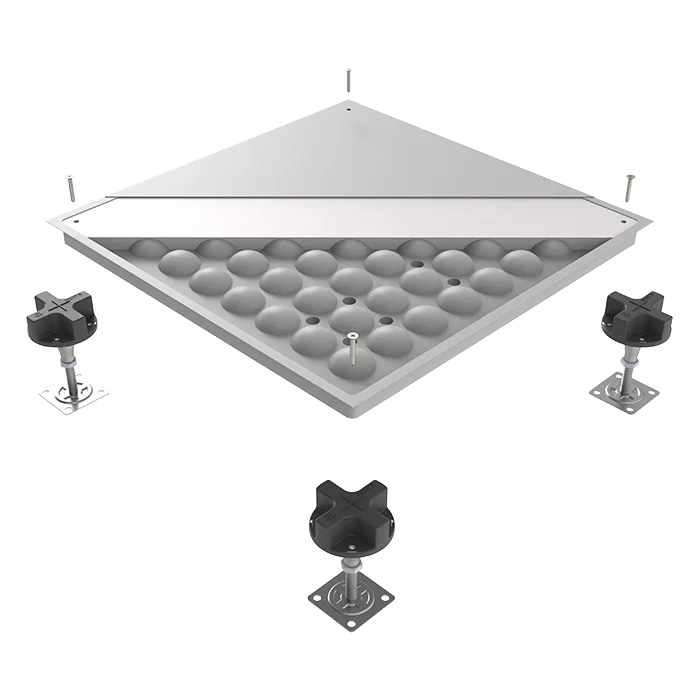
The SC series is a bare steel cementitious panel — two cold-formed steel sheets with a cementitious filler pressed between them. No integrated finish. No decorative surface. The panel is designed to be covered with carpet tile, vinyl, or laminate on site, or used as-is in technical spaces where appearance is secondary to performance.
What it delivers. The SC range spans load classes from 8 kN (SC800) to 30 kN (SC3000), making it the highest-load-capacity steel-based panel in the HUIYA lineup. The SC Raised floor system is the default specification for Tier III and Tier IV data centers, industrial production floors, telecommunications exchanges, and any environment where concentrated loads exceed 12 kN or where moisture resistance is essential.
The project that needs SC. A 2,000 m² data center in Singapore housing AI training clusters. The rack loads average 2,200 kg each. Humidity is controlled at 50 percent, but during monsoon seasons, the external RH reaches 95 percent, and any panel that absorbs moisture will degrade over time. The SC3000 panel delivers 30 kN concentrated load, total moisture immunity through its steel envelope, and A1 fire classification. No finished panel can match these specs at this price point.
Panel 2: HUIYA SCL — The Commercial Office Premium Choice
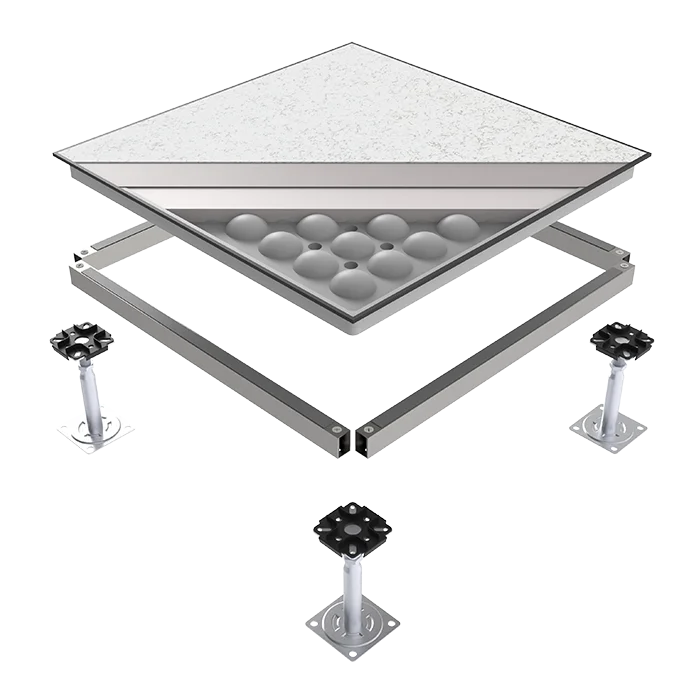
The SCL series starts with the same steel cementitious core as the SC panel but adds a factory-bonded high-pressure laminate surface during manufacturing. The laminate is not an aftermarket addition. It is integrated into the panel during the curing process — the laminate backer bonds chemically with the cementitious filler as it sets, creating a unified panel where the finish cannot delaminate from the substrate.
What it delivers. The Steel Cementious Laminate Raised Access Floor SCL panel eliminates the on-site finishing step entirely. The panel arrives with a walkable, professional-grade surface that requires no carpet, no tile, no adhesive, and no curing time. Installation crews place the panel, and the floor is immediately ready for furniture and foot traffic. Load ratings range from 8 kN (SCL800) to 30 kN (SCL3000), matching the bare SC equivalent. The cost premium for the integrated finish is typically 15 to 20 percent over the bare panel, but when the cost of on-site finishing labor and materials is factored in, the SCL panel is frequently the lower total-cost option.
The project that needs SCL. A 15,000 m² corporate headquarters in Shenzhen. The developer requires a consistent wood-grain finish across 28 floors. The construction schedule allows four days per floor for raised floor installation. With SCL panels, each floor is installed in three days — no waiting for carpet adhesion or laminate curing. The HUIYA SCL raised access floor system saved the project an estimated 22 working days compared to a bare-panel-plus-site-finish approach. The finish has a Class 33 abrasion rating under EN 13329, sufficient for high-traffic corridors and open-plan areas for a twenty-year service life.
Panel 3: HUIYA CSL — The Acoustic and ESD Specialist
The CSL series uses a high-density calcium sulphate core rather than a cementitious filler. The panel is homogeneous — no sandwich construction, no separate top and bottom sheets. The material is the structure. The calcium sulphate is pressed to a density of 1,800 to 2,100 kg/m³ and finished with a removable laminate or carpet tile surface.
What it delivers. The CSL raised floor system delivers acoustic performance that the SC and SCL panels cannot match. Weighted sound reduction indices of 38 to 42 dB compared to 28 to 33 dB for the steel cementitious panels. Inherent static dissipation — surface resistivity of 1 × 10⁴ to 1 × 10⁶ Ω — without any applied coating or additive. The material is chemically non-combustible with A1 classification and releases chemically bound water when heated, providing a fire-suppression effect in the immediate vicinity of a flame source. Load ratings are 10 to 15 kN, which covers the vast majority of data center and office requirements.
The project that needs CSL. A 5,000 m² premium office tower in London where three financial services tenants will share the building. The lease agreements include acoustic performance clauses: inter-tenant noise transfer must not exceed 40 dBA during business hours. The CSL panel's Rw 40 dB rating meets this requirement without additional acoustic underlayment. The HUIYA CSL (1000-1500) raised access floor with a factory-applied carpet tile finish is the specified panel. The integrated ESD performance protects sensitive electronics in the trading areas without requiring separate grounding mats.
Three-Way Comparison
| Attribute | SC (Steel Cementitious) | SCL (Laminate) | CSL (Calcium Sulphate) |
|---|---|---|---|
| Load Range | 8 – 30 kN | 8 – 30 kN | 10 – 15 kN |
| Surface Finish | Bare (site-finished) | Integrated laminate | Removable finish options |
| Acoustic (Rw) | 28 – 33 dB | 28 – 33 dB | 38 – 42 dB |
| ESD Performance | Coating required | Coating required | Inherent (1×10⁴–10⁶ Ω) |
| Moisture Resistance | Excellent | Excellent | Moderate (bare) / Excellent (ECS) |
| Relative Cost | $ (Lowest) | $$ | $$ – $$$ |
| Ideal Project | Data center, industrial | Corporate HQ, offices | Acoustic-critical, ESD-critical |
Regional Preferences and Specification Trends
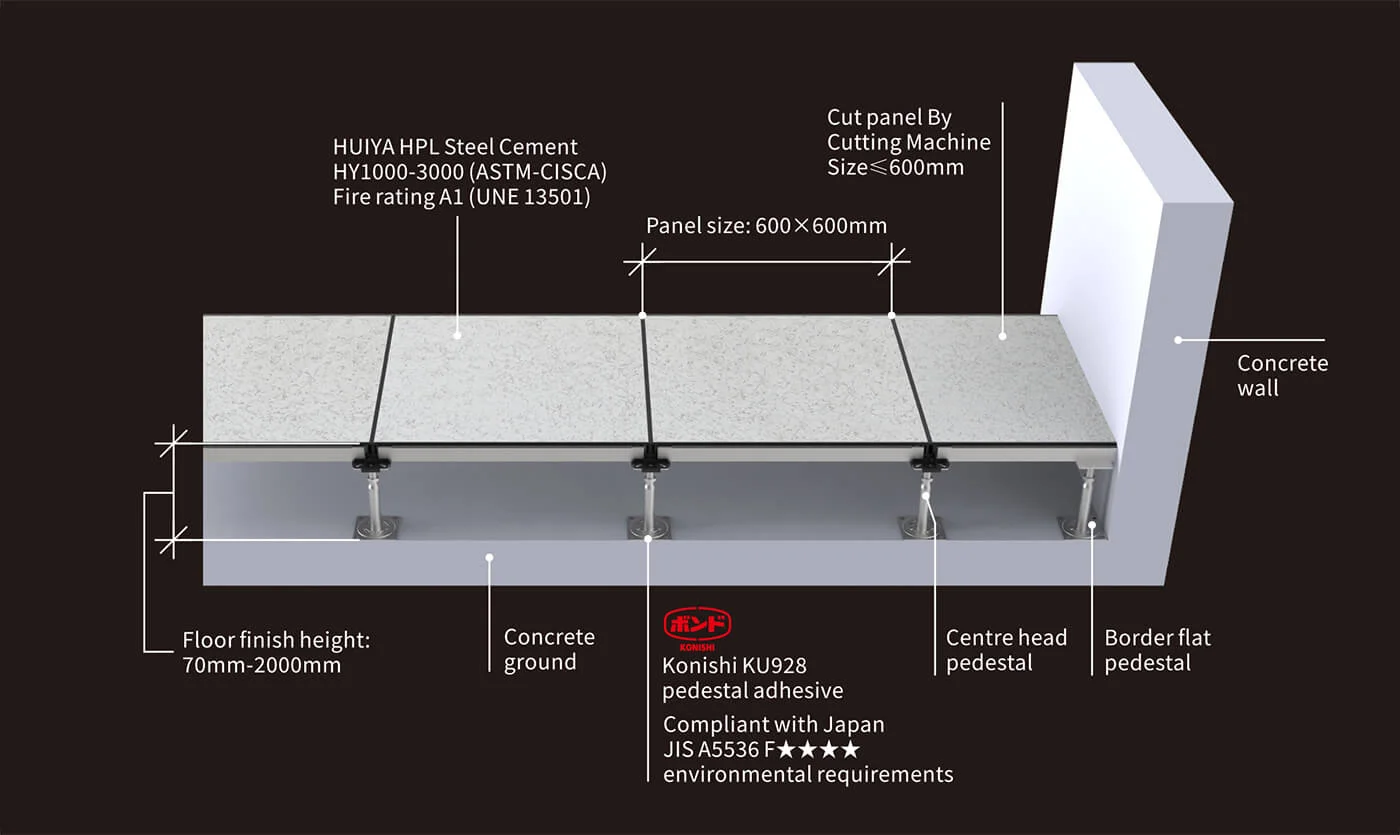
Observing how different markets select among these three panels reveals that the choice is influenced as much by local construction practices and regulatory environments as by engineering requirements. In the United States, the SC panel dominates the data center market — the Tier Standard's emphasis on structural reliability and the ubiquity of carpet tile as a finished surface make bare steel cementitious the natural choice. In Europe, CSL panels hold a larger share of the office market, driven by stricter acoustic regulations in countries like Germany and the UK, and by the EU's circular economy directives that favor materials with established recycling pathways.
In Asia, the picture is more varied. Singapore's data center builders favor SC panels for their moisture resilience, while Hong Kong's commercial developers specify CSL for premium office towers where acoustic performance is a leasing differentiator. China's rapidly expanding AI data center sector has driven demand for the highest SC load grades — the SC2500 and SC3000 — while the country's commercial office market increasingly adopts SCL panels as labor costs rise and construction schedules tighten.
Recommendation: Match the Panel to the Project, Not the Price
The most cost-effective panel for any project is the one whose performance profile aligns most closely with the project's requirements. Over-specifying an SC3000 panel for a building where loads never exceed 8 kN is a waste of capital. Specifying a CSL panel for a tropical data center where humidity exceeds 80 percent is a maintenance liability. Specifying an SCL panel for a plant room where the floor will be covered by equipment is an unnecessary finish premium.
The HUIYA SC raised access floor is the correct choice for high-load, moisture-prone environments. The SCL is the correct choice for occupied office spaces where schedule and finish quality are priorities. The CSL is the correct choice for projects where acoustic performance and ESD protection are gate requirements. When the panel matches the project, the floor performs as intended and the budget delivers maximum value.